For a decade, the “flat vs. hierarchical URLs” debate has been argued almost entirely on plumbing terms — crawl budget, click depth, page load, link equity. Both camps have a point, and Google has gone out of its way to avoid crowning a winner. But the ground underneath the argument has shifted. Search engines no longer read your site as a stack of keyword-matched pages; they read it as a map of entities — people, products, places, and concepts — and the relationships between them. Once you frame URL structure as an entity problem rather than a crawling problem, hierarchy stops being a stylistic preference and starts looking like infrastructure.
This post lays out both structures honestly, then makes the case that for any business trying to build topical authority and earn citations in AI-driven search, a clear hierarchical structure is the better default.
Also read: Is SEO Article Writing Still Effective in 2026?
Flat vs. Hierarchical URLs: The two structures, defined
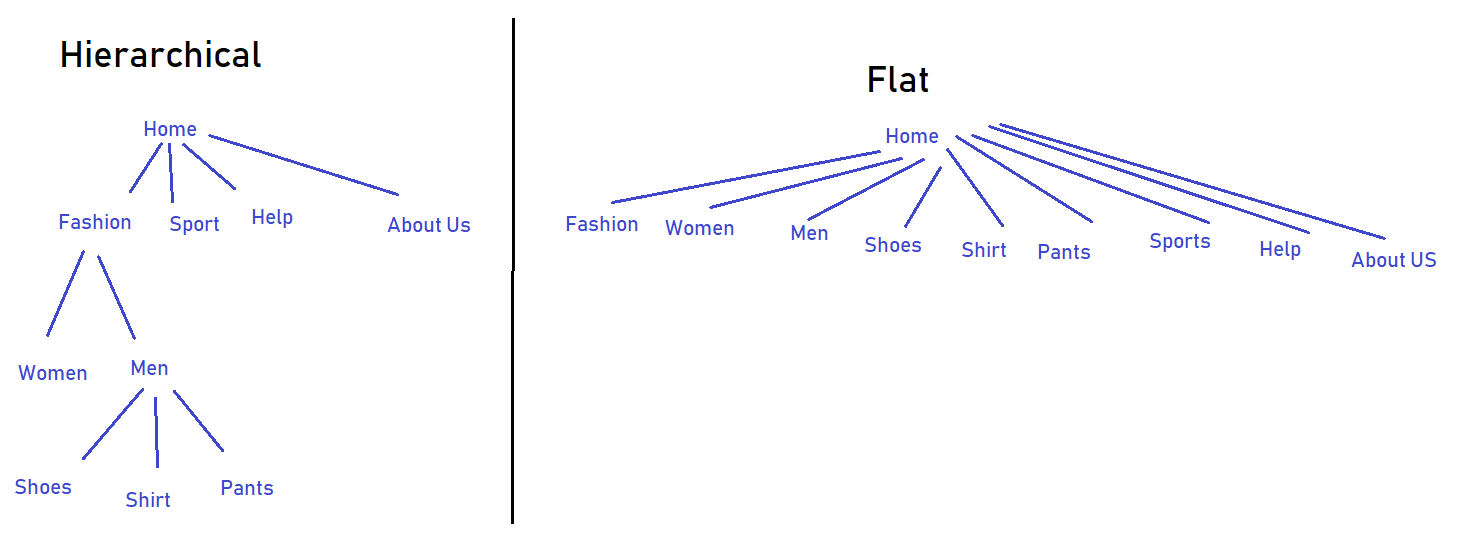
A flat URL structure keeps most pages one or two clicks from the homepage and strips out subdirectories. URLs look like example.com/url-structure-tips. They’re short, shareable, and easy to type. A flat approach suits smaller sites, single-purpose landing pages, and content libraries where every item is genuinely a peer of every other.
A hierarchical URL structure nests pages into logical categories and subcategories — example.com/blog/seo/url-structure-tips — so the path itself communicates that this is a blog post, inside the SEO category, about URL structure. As Vazoola notes, for most content-heavy sites — eCommerce stores, large blogs, service businesses — a hierarchical structure tends to be more effective because it improves internal linking, reinforces keyword relevance, and helps search engines crawl and index related content together.
Neither is “right.” The honest baseline, echoed across the SEO community, is that Google doesn’t explicitly prefer flat or deep architecture, and both can rank well when implemented thoughtfully. John Mueller has confirmed Google will crawl and index very long URLs, while still cautioning that doing so isn’t good practice. So if there’s no hard ranking penalty either way, why argue for hierarchy at all? Because the question has quietly stopped being about ranking individual pages.
What changed: search reads entities, not strings
The shift traces back to 2012, when Google moved from lexical matching to semantic understanding via the Knowledge Graph — a database of billions of entities and the relationships between them. In 2026 that’s no longer a niche concern. Google’s Gemini models are trained on the Knowledge Graph, which means how clearly your brand and topics are resolved as entities directly shapes whether you appear in AI Overviews, AI Mode answers, and other generative surfaces at all.
The numbers around this are striking. One analysis cited in the field puts the correlation between brand mentions and AI Overview visibility at 0.664, versus just 0.218 for backlinks — suggesting entity authority now predicts AI citation far better than the traditional link signal. Separately, roughly 92% of AI Overview citations reportedly come from pages already ranking in Google’s top 10, and entity clarity is what tells Google which of those top-10 results deserves to be cited as the authoritative source. Yoast’s Carolyn Shelby frames the mental model well: keyword SEO works on a flat map, while entity SEO lives in three-dimensional space, with concepts and brands clustered like constellations.
That metaphor is the whole argument in miniature. If entities live in structured, three-dimensional relationships, your site architecture — and the URLs that express it — should reflect structure, not flatten it.
Also read: AEO Tools for Brand Mentions: How to Track and Improve Your Visibility in AI Search
Pillar 1: The URL path is a free disambiguation signal
Entity SEO succeeds or fails on disambiguation. When Google encounters “Apple,” it leans on surrounding context, schema, and linked data to decide whether you mean the company or the fruit. Your URL path is one of the cheapest, most persistent context signals you can offer.
Consider what flattening costs you. A site with both /holiday/new-year/musical/ and /occasion/birthday/musical/ carries unambiguous context in each path. Collapse both into a single flat /musical/ and you’ve erased the very relationships that tell a search engine — and a user — what the page is about and how it connects to the rest of your site. Hierarchical paths reinforce a search engine’s semantic understanding of content; flat or disorganized URLs do the opposite, blurring the lines that distinguish one entity from another and diluting topical authority. In an entity model, ambiguity isn’t a minor UX wrinkle. It’s the failure mode.
Pillar 2: Hierarchy mirrors hub-and-spoke, the native shape of topical authority
Every serious entity-SEO framework converges on the same architecture: a pillar (or hub) page for a core entity, supported by spoke pages covering its attributes and subtopics, all wired together with internal links. The Postdigitalist framework is explicit that topical authority is built by consolidating entity authority through hub-and-spoke architecture first, then establishing relationships through internal linking, and only then adding schema.
A hierarchical URL structure is simply that architecture made legible in the address bar. /seo/ is the hub; /seo/url-structure-tips/ is a spoke. The path declares the parent-child relationship before a crawler has parsed a single line of body copy. This matters because entity SEO’s worst enemy is fragmentation — when teams spin up multiple pages addressing the same entity with no clear hierarchy, authority signals get divided instead of concentrated. A directory structure imposes a discipline that resists that drift: there’s an obvious home for the canonical entity page and an obvious place for everything that supports it. Flat structures, by contrast, make it dangerously easy to publish five overlapping pages as undifferentiated peers and quietly split your own authority five ways.
Pillar 3: Structured paths feed breadcrumbs, schema, and richer SERPs
Hierarchy doesn’t just help abstractly; it unlocks concrete features. Breadcrumb schema exists specifically to communicate the hierarchical structure of your site, helping search engines understand how your content and entities are organized. A clean directory structure paired with breadcrumb markup substantially improves the odds of breadcrumb trails appearing in your search results — and those trails are themselves a compact statement of entity relationships, displayed right in the SERP.
There’s a user-side benefit that loops back into entity signals, too. The URL in the browser bar acts as a virtual breadcrumb: it gives users a sense of where they sit in the content hierarchy and lets advanced users climb back up to broader sections by trimming the path. Better navigation and clearer context tend to produce stronger engagement, and engagement is one of the signals that corroborates whether your content genuinely serves a topic. Structure compounds.
Pillar 4: Consistency, the quiet prerequisite
Entities only help when they’re referenced consistently. One editor writes “Obama,” another “President Obama,” a third “Barack Obama” — same entity, three fragmented tags, divided authority. The same inconsistency creeps into URLs when there’s no structural convention to enforce. A hierarchical scheme gives your team a shared grammar: services live under /services/, locations under /locations/, each entity in a predictable place with a canonical address. That canonical-URL-per-entity discipline is exactly what entity-first workflows recommend building toward. Hierarchy is how you get it almost for free, rather than policing it page by page.
Also read: How To Get ChatGPT to Recommend Your Brand: 3 AEO Strategies That Actually Work
The honest counterargument — and why it doesn’t sink the case
Intellectual honesty requires engaging the strongest objection, and there’s a good one. Some practitioners argue that nesting content articles into deep hierarchies is unnecessary, because Google already maintains the Knowledge Graph and already knows how major entities relate to one another. By this view, schema handles classification and internal links handle architecture, so the URL path is doing redundant work. There’s truth here: for content bodies, the relationships between well-known entities are already established in Google’s graph, and you shouldn’t contort your URLs trying to re-teach Google that a US president relates to the presidency.
But notice what this objection concedes. It doesn’t say flat is better — it says hierarchy in the path is sometimes redundant for famous entities. For your own brand entities, service entities, and proprietary concepts — the things Google doesn’t already have mapped — you are the source of truth, and every structural signal helps. There’s no evidence that flat structures outperform clearly hierarchical ones; the broad consensus is that hierarchy is better for UX, crawling, and analytics, with no SERP penalty for keeping it. When one option carries clear organizational and disambiguation benefits and no measurable downside, “sometimes redundant” is not a reason to abandon it. It’s a reason to apply it sensibly.
Where flat still earns its place
Arguing for hierarchy as the default isn’t arguing for hierarchy everywhere. A few cases genuinely favor flatter paths:
- Product URLs on large stores. Most eCommerce platforms, including WordPress and Shopify, use a sensible middle ground: hierarchical category pages, but products detached into their own directory (Etsy’s
/listing/pattern). Nesting every product inside its category makes URLs rigid and breaks badly when products move between categories. Flat-ish product paths keep you flexible. - Small, single-topic sites. If you have a dozen peer pages and no real categories, manufacturing a hierarchy adds length without adding meaning.
- Avoiding excessive depth. Hierarchy is a tool, not a virtue in itself. Burying pages four or five levels deep harms crawlability and readability. Keep the tree shallow — usually no more than two or three meaningful levels — and keep the full URL in the readable 75–115 character range.
The goal is a structure that reflects your entity model, not one that performs hierarchy for its own sake.
A practical default – Flat vs. Hierarchical URLs
For most of the businesses we work with — service companies, content publishers, growing stores — the structure that best supports entity-based SEO looks like this: shallow hierarchical paths that group content into genuine topic categories (/services/seo/, /blog/local-seo/), product or item URLs detached into a flat directory for flexibility, breadcrumb schema layered on top of the directory structure, and a strict one-canonical-URL-per-entity rule enforced by the structure itself. Pair that with Organization and Service schema, consistent entity naming, and internal links that wire spokes back to their hubs, and your URL structure becomes an active contributor to topical authority rather than a neutral address.
Search has moved from matching strings to understanding things. A hierarchical URL structure is one of the simplest, most durable ways to tell search engines — and the AI systems increasingly built on top of them — exactly how the things on your site relate to one another. In the entity era, that’s not a cosmetic choice. It’s foundational.
Propellex helps small and medium businesses build entity-ready site architecture, technical SEO, and topical authority that earns visibility in both traditional SEO and AI search. Want a structural audit of your site? Reach out to maria@propellex.co or visit propellex.co.