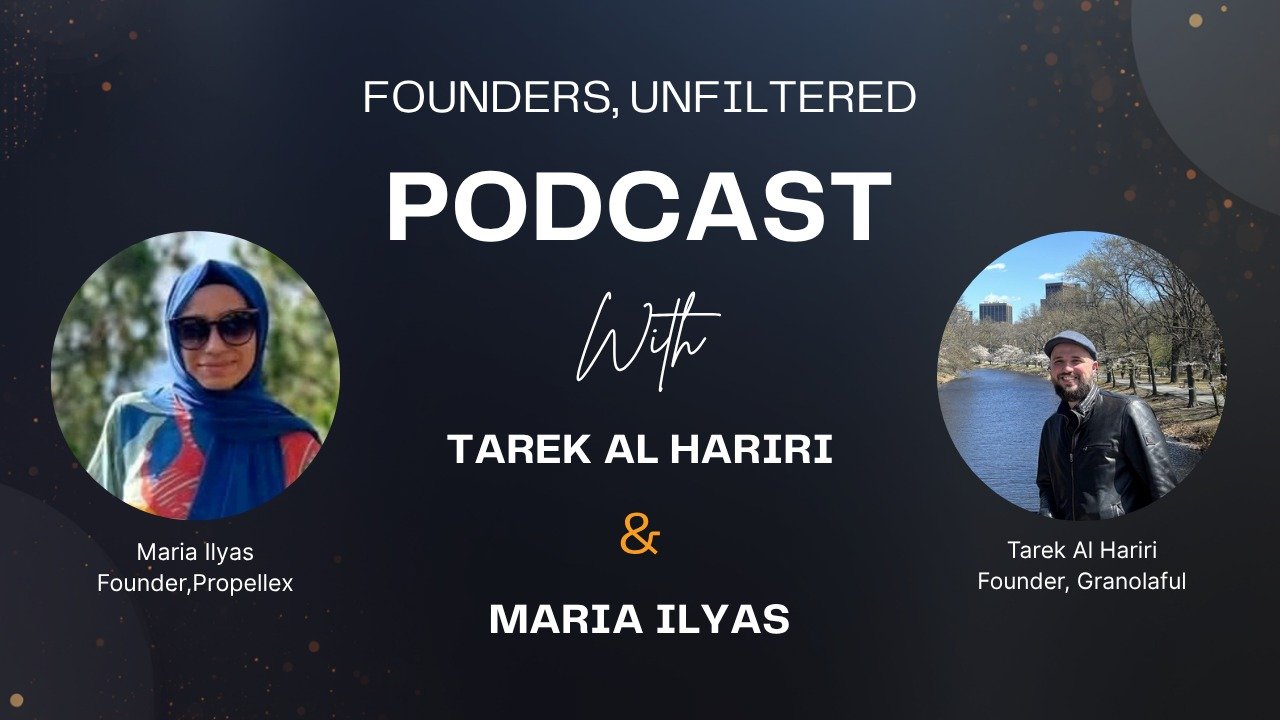
On this episode of Founders Unfiltered, we sat down with Tarek Alhariri, founder of Granolaful — the world’s first Mediterranean granola — for a raw conversation about heritage, bootstrapping, and the CPG go-to-market playbook that actually works.
Every good brand starts with a real problem. For Tarek Alhariri, the problem was sitting at his own breakfast table.
A data scientist by trade — with a background in business, technology, and merchant data across supply chain and risk — Tarek wasn’t planning to launch a food brand. But like a lot of busy parents, he found himself stuck in what he calls the “parent trap”: reaching for the quick, easy, and nutritionally empty box of cereal every single morning because it was the path of least resistance. His two-year-old son wanted Cheerios, and Cheerios is what he got.
That’s where the idea for Granolaful was born.
It started at the breakfast table
Tarek is Syrian, and his wife is Palestinian. Sitting there watching his son eat cereal, he started asking a simple question: why isn’t there a breakfast that ties back to our culture, our heritage, our region — and is as effortless as tearing open a bag of cereal?
So he made one himself. A granola built around Middle Eastern flavors: dates, black seed, even a za’atar variety. It began as a pure home project — one dad trying to make something better than his kid’s Cheerios.
But it quickly grew into something bigger than breakfast. As Tarek put it, we talk about representation across all kinds of industries, but our foods and flavors still aren’t represented on grocery shelves — especially not in the quick, Western-friendly formats people actually reach for. Launching during a period of rising anti-Arab and anti-immigrant sentiment only sharpened that mission: to carve out a space on the shelf and let a community see itself represented.
From home project to real brand
The turning point came when friends and family started asking for the granola on a regular basis. Living in Boston at the time, Tarek noticed kids in his university community genuinely loved it and kept coming back. That’s when the “maybe there’s something here” feeling kicked in.
His first real sales test? A farmers market in pouring rain, where he barely made a couple of sales.
“You can’t control the weather, and you can’t control the circumstances of who is and who isn’t coming.”
It was a humbling first day — but the passion behind the idea stuck. Granolaful has officially been a company for a little over a year, but the home-project phase ran for roughly a year before that: endless testing of herbs, spices, and ingredients. He used olive oil until it made the granola too acidic. He tried at least ten different types of za’atar before landing on the signature blend. Only once there was genuine demand and some real product-market fit did he take it to local events and build out an e-commerce strategy.
The best proof of concept, though, is at home. His son — now almost five — still picks granola over Cheerios every time, and has graduated from taste-tester to product manager, constantly asking, “Baba, what’s the next flavor?”
Authenticity you can taste
One of the sharpest parts of the conversation was how Tarek balances authenticity with mainstream appeal. His anchor is the Mediterranean diet — widely ranked among the healthiest in the world — which means no seed oils and genuinely pure ingredients like natural seeds and specific nuts.
He’s realistic about the constraints. Despite the grain-free movement, granola is still an oat-based product for most shoppers, so he isn’t fighting that. Instead, Granolaful doubles down on authenticity where it counts: the flavors, the oils, and ingredients like black seed and date syrup (which is gradually replacing honey).
The black seed flavor is a perfect example of the craft involved. Black seed is intensely strong on its own, and Tarek uses a lot of it — roughly a quarter of the granola. Rather than dial it back, he balances it against oats, a coconut base, and a touch of sweetness, so you still get that bold, “wow, what is that?” punch without it overwhelming the bowl. It’s the opposite of the industry shortcut of dumping in sugar, additives, and flavorings and calling it a day.
The go-to-market maze
When it came to selling, Tarek experimented with every channel — and had strong opinions on each.
He started in person at farmers markets and events, and still champions it for early-stage CPG brands. The reason is simple: direct feedback. You can watch someone’s face in real time, including the honest, unfiltered reactions from Westerners tasting black seed or za’atar for the first time. That kind of signal is nearly impossible to fake — and impossible to get from a shelf.
“Seeing is believing, talking is learning.”
From there he expanded into retail (with Granolaful heading into Halal Basket in Houston) and e-commerce. He’s blunt about how hard online is: retail asks people to buy off a shelf, but e-commerce first has to convince someone to click your ad and visit your site at all — an uphill battle for any early brand without existing buzz.
Amazon turned out to be one of the most valuable channels because of its high purchase intent, though he offers an important caveat: Amazon customers are Amazon’s customers, not yours. That’s why he preaches a full funnel — your own website, some retail, and in-person — all working together to create a “halo effect,” where sales on one channel lift recognition and sales on the others.
What actually worked (and what burned cash)
Granolaful is 100% bootstrapped, with a small friends-and-family round and no big funding chase — at least not yet. That constraint forced Tarek to get sharp about where every dollar goes, and this is where the episode delivered the most gold for other founders:
- Meta ads didn’t work for them. A few hundred dollars in drove some new followers but zero sales, so he pulled the plug. His honest read: ROAS lives and dies on creative, and without an in-house designer (and with outsourcing being expensive against thin CPG margins), it wasn’t worth it.
- Amazon-first for early spend. Tarek repeated advice he got from a fellow CPG founder: with $100, $1,000, or even $5,000 in budget, put it into Amazon ads. Only past that point do returns taper enough to justify diversifying into Meta or Google. Amazon captures people already searching to buy.
- Bottom-of-funnel beats top-of-funnel early on. Someone searching “healthy cookies” on Amazon and seeing your ad is far more likely to convert than hundreds of thousands of cold impressions on Meta. Build brand awareness at the top after you’ve nailed the bottom.
- Repeat purchase rate is the real metric. For a consumable product, you don’t need to break even on the first order. It’s the second, third, and fourth reorders — the long tail — that recover your investment and tell you you’re building a snowball instead of chasing one-and-done buyers.
- Affiliates and community over paid ads. Tarek leaned on brand affiliates and influencers who genuinely loved the product (some posted without even telling him) and pointed to community-led founders who barely need paid ads because they’ve built a real following. His own admission: consistent, founder-led content is the highest-ROI activity — and it’s the medicine he’s still working on taking himself.
Tarek’s advice for first-time founders
His parting advice was refreshingly direct.
Don’t rush to hire an agency. Every agency promises the world. As a founder, you’re already juggling operations, logistics, and customers — but you need to learn marketing A to Z yourself first, so that later you can actually tell the difference between someone doing great work and someone just managing your account. He was especially wary of account managers who optimize spend up and down with no real strategy behind it.
Set a small budget you’re prepared to burn. A hundred or two hundred dollars, whatever’s comfortable — expect to lose it, keep testing, and keep tweaking. The only real mistake is spending nothing at all (unless you’re deliberately building a community instead).
Start small and improve relentlessly. Channeling his data-scientist roots, Tarek is a believer in the iterative, agile approach — even a 1% improvement compounded over a year is enormous. A year ago, Granolaful didn’t even have branded packaging; the product shipped in plain brown bags. Look back after twelve months of small steps, and you’ll be amazed how far it’s moved.
And above all: just start. As Tarek put it, the worst that happens is it doesn’t work — and even then, everything you learn carries directly into whatever you do next. For him, the lessons from Granolaful feed straight back into his own career.
Where to find Granolaful
If you want to try it for yourself:
- Follow Granolaful on Instagram and TikTok [@granolaful — confirm exact handle] and DM for a discount code on their Amazon listing.
- Find them on Amazon (the website is often priced a little lower).
- In the Houston area? Grab it at Halal Basket — reach out to Tarek directly to make sure you get your first order sorted.
Thanks to Tarek Alhariri for joining us on Founders Unfiltered. Watch or listen to the full episode :Building a CPG granola brand with Tarek Alhariri, Founder of Granolaful for the complete conversation — including the flavor experiments that didn’t make the cut and the story behind that very rainy first farmers market.