Search is changing fast. With AI-generated answers now appearing directly in Google, Bing, and platforms like ChatGPT, small businesses are asking a new question: “Do I still need SEO, or do I need GEO Services as well?”
The answer, increasingly, is both. But they’re not the same service.
Generative Engine Optimization (GEO) has emerged as a distinct discipline from traditional SEO, and smart marketing agencies are learning how to package, price, and explain the difference to clients. If you’re running an agency — or considering hiring one — understanding how GEO differs from a standard SEO retainer is critical to setting the right expectations and getting real results.
This article breaks down exactly how agencies are separating these two services, why the distinction matters, and what it means for your marketing strategy.
What Is GEO, Really?
GEO stands for Generative Engine Optimization. It refers to the practice of optimizing content so it gets cited, summarized, or referenced by AI-powered answer engines — think ChatGPT, Google’s AI Overviews, Perplexity, and Bing Copilot.
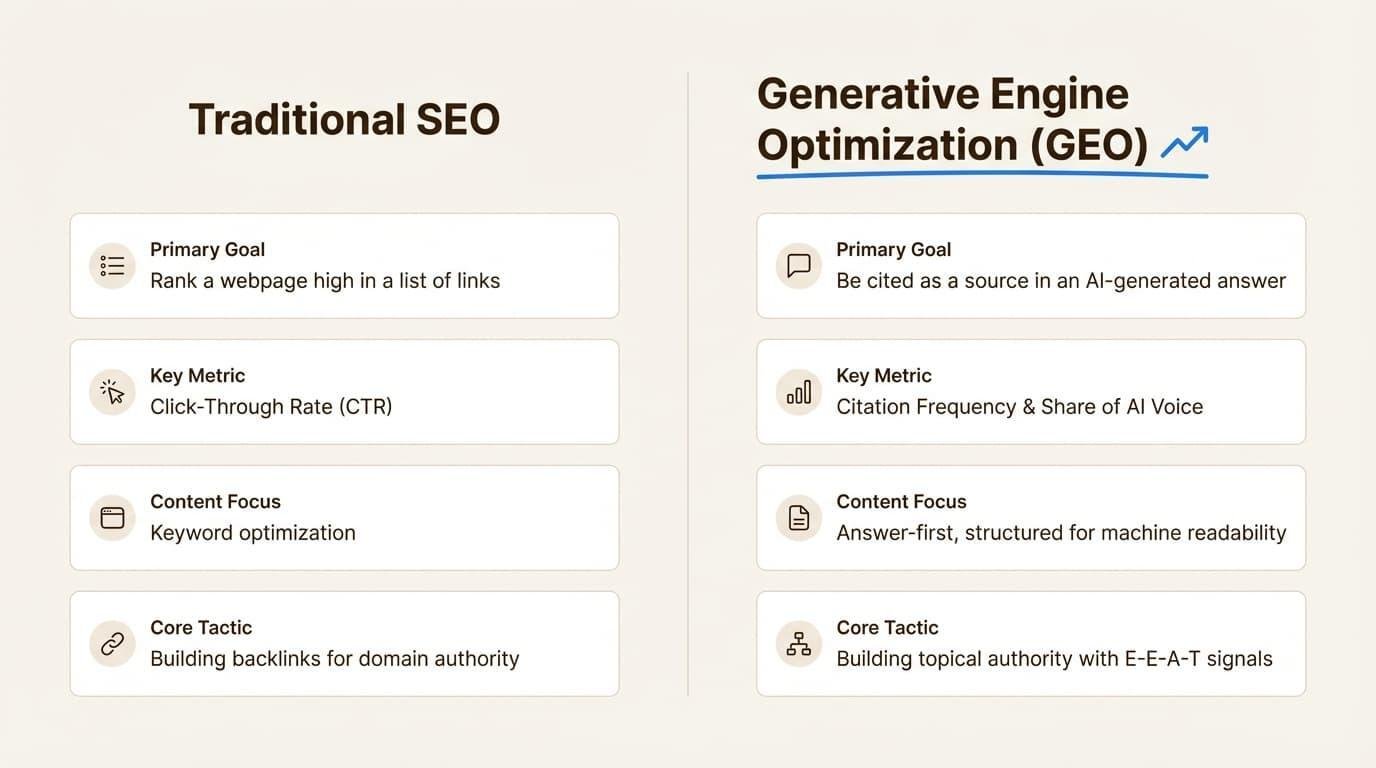
Unlike traditional search, where the goal is ranking on a results page, GEO is about becoming the source an AI model pulls from when generating a direct answer to a user’s question.
This is a fundamentally different goal than climbing to position one on Google.
Why GEO Emerged as Its Own Category
Search behavior itself is shifting. Users increasingly type questions into AI chat tools instead of search bars. Instead of clicking through ten blue links, they get a synthesized answer with maybe two or three sources cited.
If your business isn’t one of those cited sources, you’re invisible in that interaction — even if you rank well on Google. Agencies recognized this shift meant SEO tactics alone weren’t enough, and GEO needed its own strategy, deliverables, and pricing structure.
Also read:GEO: Generative Engine Optimization for Local Service Businesses
Standard SEO Retainers: What They Actually Include
Before comparing the two, it helps to define what a typical SEO retainer covers.
Core SEO Retainer Deliverables
Most SEO retainers for small businesses include:
- Keyword research and tracking
- On-page optimization (titles, meta descriptions, headers)
- Technical SEO audits (site speed, crawlability, indexing)
- Link building and outreach
- Local SEO management (Google Business Profile, citations)
- Monthly reporting on rankings and organic traffic
The focus is on ranking in traditional search engine results pages, driving organic clicks, and improving domain authority over time.
The Metrics That Matter for SEO
Standard SEO success is measured through:
- Keyword rankings
- Organic traffic growth
- Click-through rates
- Domain authority scores
- Conversion rates from organic search
These are well-established KPIs that clients understand and agencies have tracked for over a decade.
How GEO Services Are Structured Differently
GEO isn’t just “SEO for AI.” It requires different inputs, different content formats, and different success metrics. Agencies are building GEO into distinct service packages rather than folding it quietly into existing SEO work.
Content Structured for Extraction
AI models don’t rank pages — they extract and synthesize information. That means content needs to be structured for easy extraction: clear definitions, direct answers to questions, well-organized lists, and concise summaries near the top of a page.
Agencies offering GEO often rewrite or restructure existing content specifically so AI tools can pull accurate, quotable snippets from it.
Entity and Authority Building
AI answer engines rely heavily on establishing which sources are trustworthy authorities on a topic. This means GEO work often includes:
- Building out consistent brand mentions across the web
- Strengthening author bios and credentials (E-E-A-T signals)
- Getting cited on high-authority third-party sites
- Structured data and schema markup to clarify entities
This goes beyond backlinks. It’s about being recognized as a credible source of information, not just a page with strong links pointing to it.
Monitoring AI Citations, Not Just Rankings
Instead of tracking a keyword’s position on page one, GEO reporting tracks whether — and how often — a business is cited in AI-generated answers.
Agencies now use specialized tools to monitor:
- Brand mentions inside ChatGPT and Perplexity responses
- Appearance in Google’s AI Overviews
- Share of voice compared to competitors within AI-generated summaries
- Sentiment and accuracy of how the brand is described
This is a completely different reporting dashboard than a standard SEO retainer.
Why Agencies Are Separating GEO Into Its Own Retainer
Bundling GEO into existing SEO packages might seem simpler, but most agencies are finding good reasons to keep them separate.
Different Skill Sets Are Required
SEO specialists are trained in technical audits, backlink strategy, and keyword mapping. GEO requires additional skills: understanding how large language models process and summarize information, structuring content for AI parsing, and monitoring citation-tracking tools that didn’t exist two years ago.
Agencies are hiring or training specifically for this, and that specialized labor needs its own line item.
Client Education Requires Clear Boundaries
If GEO is silently folded into an existing SEO retainer, clients may not understand why their invoice increased or what new value they’re getting. By naming GEO as its own service, agencies can clearly explain:
What’s new
Why it matters
What outcomes to expect
This transparency builds trust and justifies pricing adjustments.
Reporting Requires Separate Benchmarks
Since GEO doesn’t move traditional ranking metrics, mixing it into an SEO report creates confusion. A client might ask, “Why isn’t this affecting my Google rankings?” when the actual goal was AI visibility, not keyword position.
Separating the retainers means separating the KPIs, which keeps reporting clean and expectations realistic.
Also read: Affordable GEO Services: A Practical Guide to Generative Engine Optimization
What This Means for Small Business Owners
If you’re a small business evaluating agency services, here’s how to think about the distinction.
Ask What Outcome You’re Paying For
SEO retainers are about organic search visibility and website traffic. GEO retainers are about being cited and represented accurately when customers ask AI tools questions related to your business.
Both matter, but they solve different problems.
Consider Your Industry and Audience
If your customers are increasingly using ChatGPT or AI search tools to research services, GEO becomes more urgent. If your business relies heavily on local search and Google Maps visibility, traditional SEO — especially local SEO — still carries significant weight.
Most small businesses benefit from both, but budget constraints may mean prioritizing one first.
Expect Evolving Pricing Models
Because GEO is newer and requires specialized tools and expertise, agencies often price it as an add-on or a separate tier rather than bundling it into legacy SEO pricing. Expect this to evolve as the technology and tracking tools mature.
The Bottom Line
GEO and SEO are related but distinct disciplines, and agencies are increasingly treating them that way. SEO focuses on ranking in traditional search results; GEO focuses on becoming a trusted source that AI engines cite directly.
For small businesses, understanding this difference means asking better questions when evaluating agency proposals — and making sure you’re paying for the right outcome, with the right metrics to prove it’s working.
As AI-driven search continues to grow, the businesses that invest in both traditional SEO and generative engine optimization will be the ones showing up — whether a customer is scrolling through search results or simply asking an AI assistant for a recommendation.
Hire Propellex for GEO Service