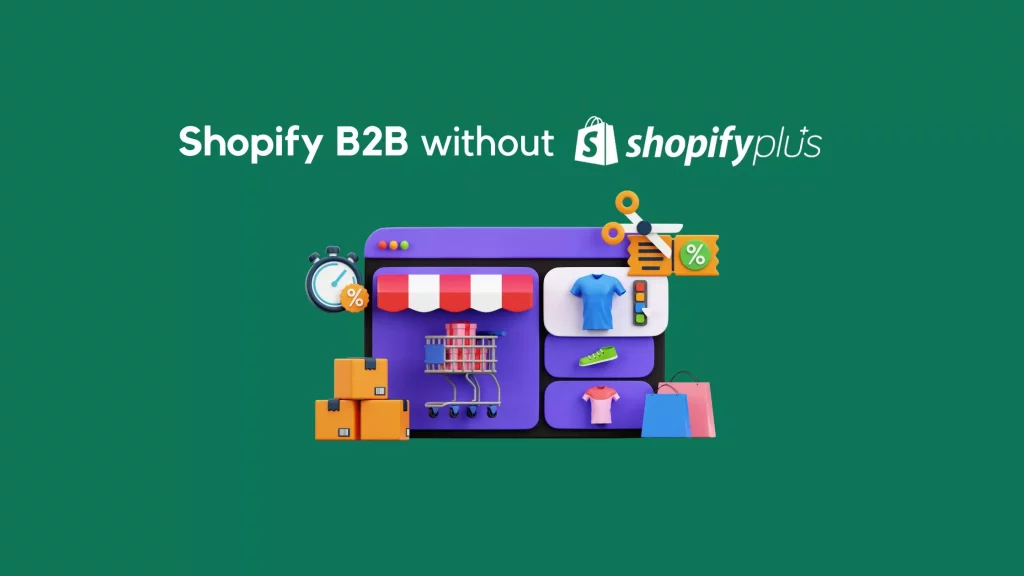
The Best Shopify B2B Apps in 2026: A Complete Guide for Wholesale Merchants
Selling business-to-business on Shopify used to feel like forcing a square peg into a round hole. The platform was built for shoppers who browse, add to cart, and check out in a single session. B2B buyers don’t work that way. They negotiate prices, expect net payment terms, place repeat orders by SKU, and route purchases through procurement managers and approvers.
The good news: Shopify’s B2B ecosystem has matured dramatically. As of 2026, Shopify rolled out native B2B features to merchants on standard plans (not just Plus), and a strong app ecosystem fills the remaining gaps. Whether you’re a small wholesaler graduating from Excel order sheets or a mid-market brand serving hundreds of retailer accounts, there’s a configuration that fits. Not sure if Shopify is even the right starting point for your store? Our guide on building a website with AI covers the honest answer for small businesses.
This guide breaks down the best Shopify B2B apps in 2026, organized by what they actually do, with honest notes on pricing and trade-offs.
First: Do You Actually Need a Third-Party App?
Before installing anything, check what Shopify gives you out of the box.
In late 2025 and early 2026, Shopify expanded its native B2B capabilities beyond Shopify Plus. Merchants on Basic, Growth, and Advanced plans can now access company profiles for wholesale buyers, up to three custom catalogs with tailored pricing, volume discounts, quantity rules, vaulted credit cards, and basic payment terms.
Shopify Plus (starting around $2,300/month) goes further, offering unlimited pricing catalogs, direct catalog assignment to companies and locations, partial payments, deposits, expansion stores for separate B2B/D2C storefronts, and deeper customization through Shopify Functions and Checkout Extensibility.
If you’re a small wholesaler with simple needs and fewer than three pricing tiers, native Shopify B2B may be enough. But once you need a self-service buyer portal, sales rep tools, advanced quoting, CSV ordering, or sophisticated registration workflows, you’ll want a dedicated B2B app.
All-in-One Shopify B2B Apps
These apps replace or extend Shopify’s B2B layer with a full suite of wholesale features. They’re the right starting point if you want a single tool to handle pricing, ordering, and customer management.
1. SparkLayer B2B & Wholesale
SparkLayer is one of the most highly rated B2B apps in the Shopify ecosystem, holding a 4.9-star rating across hundreds of reviews and used by brands like Teapigs, Living Proof, and Cubitts. It works on both standard Shopify and Shopify Plus, making it accessible without an enterprise plan upgrade.
What it does well:
- Customer-specific pricing through base price lists, tiered lists, promo lists, and per-customer custom pricing
- Self-service buyer portal where customers can place orders, track shipments, manage shopping lists, and reorder with one click
- Sales agent functionality so reps can place and manage orders on behalf of accounts
- Automatic volume discounts as quantities increase
- Multi-language and multi-currency support for international wholesale
- Integration with accounting tools like Xero and QuickBooks Online
Pricing: Free plan available, with paid plans starting around $49/month. Higher tiers unlock the sales agent portal, advanced discount rules, and quoting.
Best for: Brands wanting a polished self-service ordering experience without upgrading to Shopify Plus.
2. BSS B2B Wholesale Solution
BSS Commerce has built one of the most feature-dense B2B suites on the Shopify App Store. It’s particularly popular with merchants who need a cost-effective alternative to Shopify Plus while still running complex wholesale operations.
What it does well:
- Custom pricing by tag, with tiered discounts and bulk pricing rules organized into price lists per customer group
- Multi-step B2B registration forms with approval workflows and auto-tagging
- Quantity rules including minimum order quantity (MOQ), order limits, and quantity breaks
- Automated tax-exempt rules and VAT support for EU compliance — a meaningful advantage for European wholesalers
- Net terms, manual orders, and multi-currency discount support at B2B checkout
- Public APIs and Shopify POS integration so B2B pricing applies online and in person
Best for: Merchants on standard Shopify plans who need enterprise-level B2B features (especially around tax and pricing complexity) without the Plus price tag. The UI takes some getting used to, but the depth is hard to match.
3. Wholesale Gorilla
Wholesale Gorilla was built by actual Shopify store owners running their own wholesale operations, and that practical bent shows. It’s been around since 2013 and is known for affordability and responsive support.
What it does well:
- Tiered pricing by product, collection, or customer tag without duplicating your store
- Net checkout so buyers can place orders and pay later with payment terms
- A professionally designed Quick Order Form that blends with your store’s branding
- Wholesale shipping rules, order limits, and product exclusions
- CSV price upload, customizable signup forms, and product/page locks on higher tiers
- A dedicated wholesale buyer portal
Pricing: Free plan available; paid plans go up to around $149.95/month for the Premium tier, which unlocks volume discounts, payment terms, advanced product-lock rules, and priority support.
Best for: Small-to-mid wholesalers who want a balance of features, price, and ease of use, especially those who value strong customer support.
Pricing & Discount Specialists
Sometimes you don’t need an all-in-one platform; you just need bulletproof wholesale pricing rules. These apps focus narrowly on that.
4. Wholesale Pricing Discount B2B (by Wholesale Helper)
Wholesale Helper has built a suite of B2B tools used by over 13,500 merchants. Its flagship Wholesale Pricing Discount B2B app is one of the most popular Shopify wholesale pricing solutions.
What it does well:
- Tiered pricing based on volume or customer tags
- Wholesale sign-up forms with approval workflows
- Net payment terms and advanced shipping rates available at lower price tiers (starting around $44.99/month) than many competitors
- Multi-currency, VAT, and global wholesaling support
- Integrations with other Shopify apps for a modular tech stack
The Wholesale Helper ecosystem also includes Wholesale Lock Manager B2B (for hiding products and prices from non-approved customers) and WSH Order Form & ReOrder (a single-page bulk order form), which can be combined for full functionality without paying for a higher-tier all-in-one app.
Best for: Merchants who want to assemble a modular B2B stack and access core features (like net terms) at lower price points than bundled platforms offer.
Bulk Ordering & Order Forms
B2B buyers placing orders for dozens or hundreds of SKUs don’t want to click through individual product pages. They want a spreadsheet-like interface.
5. WSH Order Form & ReOrder
This Wholesale Helper app gives B2B customers a grid-style order form for fast bulk ordering and easy reorders of past purchases. It’s particularly valuable for wholesalers whose customers reorder the same SKUs repeatedly — distributors, retailers restocking inventory, and food service buyers. Want to sweeten repeat orders without installing extra apps? See how to auto-add free gifts in Shopify without using any app.
6. Easy:Wholesale Bulk Order Form
A lighter-weight alternative that adds dedicated wholesale pages with quick order forms. It includes a floating order summary bar for large catalogs and lets you customize colors, text, and layouts to match your branding. For further storefront customizations without apps, check out our guide on creating a custom Shopify announcement bar without an app.
7. MultiVariants
If you sell products with many variant combinations (apparel in multiple sizes and colors, for example), MultiVariants displays variants in table, grid, or matrix layouts so buyers can quickly enter quantities across the full SKU range. It also enforces minimum and maximum order quantities per variant or combination. If managing variant visibility is a priority, see our guides on hiding out-of-stock variants in Shopify and hiding out-of-stock variants in Shopify bundle products.
Access Control & Gated Catalogs
Many wholesalers don’t want retail customers seeing wholesale prices or even knowing certain products exist.
Running bundles alongside your wholesale catalog? You’ll also want to make sure unavailable options stay hidden — check out our step-by-step guide on hiding out-of-stock variants in Shopify bundle products.
8. Wholesale Lock Manager
This app restricts storefront access so only approved customers can view prices, products, or specific pages. Great for brands running a private wholesale catalog alongside a public retail store, or for those who require buyer approval before revealing pricing.
Net Terms & Deferred Payment
Offering payment terms is table stakes for serious B2B. Shopify Plus includes native net terms, but standard plans need help.
9. Charge Me Later
One of the simplest ways to offer deferred payment outside of Shopify Plus. Buyers complete checkout without paying upfront, and you charge them on a date you set. It’s a clean solution for merchants who want net 30 or net 60 without committing to a full enterprise platform.
Automation & Operations
Wholesale workflows generate a lot of manual coordination — approving accounts, routing large orders, alerting sales reps. Automation tools pay for themselves quickly.
10. Mechanic
Mechanic is a highly flexible automation app trusted by B2B brands and agencies. It can trigger emails or Slack alerts to your sales team when a lead registers, auto-tag new leads as “awaiting approval,” pause fulfillment for orders above a threshold for manager review, and unlock special offers for VIP-tagged customers.
It pairs especially well with SparkLayer or BSS, sitting underneath them to handle the workflow logic that comes after a lead or order hits your store.
11. Shopify Flow
Don’t overlook the native option. Shopify Flow is free on Plus (and available with limitations on lower plans) and can handle a lot of B2B automation — assigning wholesale pricing tags, routing orders by value, sending notifications, and updating inventory.
Post-Sale: Retention, Returns, and Support
The sale isn’t the end of the relationship. B2B accounts that reorder predictably are worth far more than one-time conversions. If you’re still converting buyers through a general catalog page, it’s worth understanding what an ecommerce landing page is and why it matters for growth.
12. Smile: Loyalty & Rewards
While built for retail loyalty, Smile works well for B2B retention when configured for wholesale tiers — rewarding reorders, anniversary purchases, or referral-based account growth.
13. Return Prime
Returns in B2B are messier than B2C (case packs, damaged shipments, partial returns). Return Prime gives you a structured returns and exchanges workflow that scales with wholesale volume.
14. Gorias / Richpanel
Customer support tools that integrate with Shopify orders, surfacing the full account history when a B2B buyer reaches out. For accounts placing orders weekly, this context dramatically speeds up resolution.
How to Choose the Right Stack
The single biggest mistake merchants make is hunting for one app that does everything. B2B workflows are genuinely complex, and the most successful wholesale stores layer two to four specialized tools rather than relying on a single platform.
A practical starting framework:
If you’re just starting wholesale (under $100k annual B2B revenue): Start with Shopify’s native B2B features. If you need more, add Wholesale Gorilla or BSS B2B Wholesale Solution. Total cost: under $100/month.
If you’re scaling (under $1M annual B2B revenue): SparkLayer or BSS as your core platform, plus a dedicated order form app like WSH Order Form, plus Mechanic or Shopify Flow for automation. Add an accounting sync if you’re using QuickBooks or Xero.
If you’re at enterprise scale (over $1M B2B revenue): Shopify Plus for native company accounts, expansion stores, and Checkout Extensibility. Layer on SparkLayer if you need a sales agent portal or advanced quoting that Plus doesn’t include natively. Integrate with ERP and CRM through dedicated middleware.
Common Pitfalls to Avoid
A few things experienced wholesalers wish they’d known earlier:
Don’t duplicate your store. Running a separate Shopify store for wholesale used to be the norm, but it splits inventory, doubles your maintenance overhead, and creates data sync headaches. Modern B2B apps let you run wholesale and retail from one store.
Don’t pay enterprise prices before you need them. Shopify Plus at $2,300/month makes sense for many businesses, but if you’re early in your B2B journey, an app like SparkLayer or BSS on a standard Shopify plan often covers 80% of what Plus offers at a fraction of the cost.
Watch the feature gates. Many B2B apps reserve essential features (net terms, custom registration forms, quantity rules) for their highest pricing tiers. Read the feature matrix carefully before committing.
Test the buyer experience end-to-end. Sign up as a wholesale customer on your own store. Place a test order. Try a reorder. The friction points you find are the same ones that cost you real accounts.
The Bottom Line
Shopify in 2026 is a genuinely capable B2B platform, and the app ecosystem has matured to the point where you can build a wholesale operation that rivals what enterprise platforms used to charge six figures to deliver.
For most merchants, the right path looks like this: lean on Shopify’s native B2B features as the foundation, add an all-in-one app like SparkLayer, BSS, or Wholesale Gorilla as your wholesale layer, and bolt on specialists (order forms, automation, returns) only where you have a specific gap.
Start with the workflow that’s costing you the most time today. Solve that first. Then iterate. And if you need expert help setting up or scaling your Shopify store, check out our Shopify development service.