Here are 2 case studies on improving brand visibility through AEO strategies. How two Propellex clients — Kaylaan, a national e-commerce brand, and Spartan Tax, a local CPA firm — earned a place inside Google’s AI answers, and what their wins reveal about answer engine optimization.
Search stopped being a list of links
For twenty years, “being found” meant ranking. You earned a blue link near the top of page one and the click followed. That model is quietly breaking. The two case studies on improving brand visibility through AEO strategies that follow — one e-commerce, one local — are about what comes next. By 2026, AI Overviews were appearing on close to 55% of Google searches, and Gartner had projected that traditional search volume would fall by roughly 25% as people moved their questions to AI assistants. Around half of Google searches now end without a single click — the answer arrives on the results page itself, often naming just one or two brands.
That single shift rewrites the goal. The question is no longer “do we rank?” It’s “are we in the answer?” Answer engine optimization (AEO) — sometimes called GEO — is the discipline of structuring your content and your reputation so AI answer engines cite and recommend you when they generate a response. Improving brand visibility now means showing up inside that answer, not three links below it.
Below are two Propellex clients who went from absent to cited. They operate in completely different worlds, which is exactly the point: the same principles moved both.
Also read: How To Get ChatGPT to Recommend Your Brand: 3 AEO Strategies That Actually Work
What AEO actually is (and isn’t)
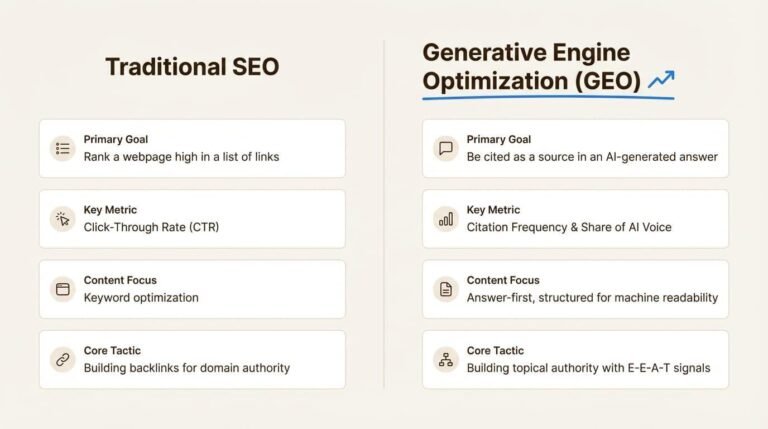
AEO is not a replacement for SEO. Google’s own 2026 guidance is blunt about this — there is no secret AI-only schema, and the fundamentals that make a page eligible for Search are the same ones that make it eligible to be cited in AI Overviews and AI Mode. Independent analyses agree: a large share of AI Overview citations still come from pages already ranking in the top ten of organic results.
What AEO adds is a layer of tactics aimed at the exact moment an AI chooses its sources:
- Answer-first, extractable content — lead with the concrete answer, not a warm-up paragraph. AI engines lift specific facts and skip the fog.
- Entity clarity — an unambiguous, consistent description of who you are, what you do, and where, repeated accurately across your site and major listings.
- Third-party validation — the off-site signals (reviews, community discussion, earned mentions) that an AI treats as proof you are real and recommended.
- Structured data and freshness — schema that matches your visible content, and pages kept current.
Two honest caveats before the case studies. First, no agency can guarantee a spot in an AI answer; anyone who promises one is selling smoke. Second, a citation is not automatically a click — AI referral traffic is still a small slice of total web traffic today, though it is growing fast and tends to convert well. AEO is a high-quality, early-mover channel, not a volume firehose, and we treat it accordingly.
Case study 1 — Kaylaan: winning a crowded consumer category
The client. Kaylaan makes zero-waste, fluoride toothpaste tablets — a small, fiercely contested corner of e-commerce shared with names like Bite, Huppy, Unpaste, and Smyle.
The challenge. “Best toothpaste tablets with fluoride” is a textbook high-intent query: someone with a credit card open, comparing brands. In 2026 that comparison increasingly happens inside an AI Overview, before the shopper ever reaches a product page. To win the sale, Kaylaan didn’t just need to rank — it needed to be the brand the AI named, and to be described accurately enough that a careful buyer would trust it.
The strategy. We built around the signals AI engines actually reward in a commercial category:
- Hyper-specific, citable product facts. AI lifts concrete claims, so we made Kaylaan’s defining details impossible to miss and easy to extract: 1,000 ppm sodium fluoride, B Corp certification, an SLS-free formula, and a five-flavor trial pack. These are exactly the kind of verifiable points that get pulled into an answer.
- Authentic community presence. Reddit is now among the most-cited sources in AI search — Semrush found it appears in roughly 40% of LLM citations across the major engines, and in May 2026 Google began pulling Reddit “Community Perspectives” directly into AI Overviews. We focused on genuine participation in the threads where buyers actually compare tablets, not astroturf — which today’s models are good at detecting.
- Earned mentions over raw backlinks. The off-site evidence — being discussed and recommended on third-party sites — is what AI weighs most heavily; research puts the large majority of AI citations on external sources rather than a brand’s own pages. We worked the reputation layer, not just the website.
- Answer-ready owned content. On Kaylaan’s own pages, we structured the fluoride question, the brand comparisons, and the FAQs so an engine could extract a clean answer.
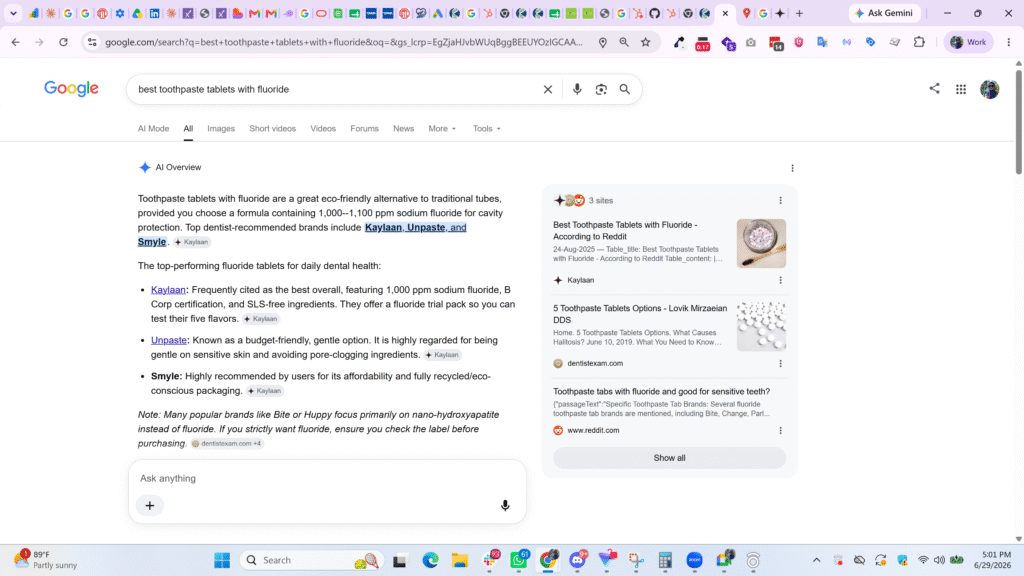
The result. Search “best toothpaste tablets with fluoride” on Google and Kaylaan is the first brand the AI Overview recommends — described, in the AI’s own words, as frequently cited as the best overall, complete with the 1,000 ppm fluoride, B Corp, and SLS-free details, plus the trial pack. The supporting source panel includes a Reddit thread on the very same question. In a category dominated by bigger incumbents, Kaylaan is now the default answer.
Case study 2 — Spartan Tax: winning a local services category
The client. Spartan Tax Group is a veteran-owned CPA firm in Land O’ Lakes, Florida, built for small businesses — offering year-round tax strategy, IRS problem resolution, and a flat-rate membership model.
The challenge. Local discovery has moved faster than almost any other corner of search. BrightLocal’s 2026 Local Consumer Review Survey found the share of consumers using AI to find local businesses jumped from 6% in 2025 to 45% in 2026 — one of the fastest behavior shifts ever recorded in search. On a query like “accountant in Land O’ Lakes,” there is no page of ten links to climb; the AI reads the web and names a firm or two. The upside: research in 2026 found that the overwhelming majority of local businesses still have no strategy for showing up in AI search at all. The field is wide open for whoever moves first.
The strategy. Local AEO is an entity-and-trust game, so that is where we concentrated:
- Consistent entity and profile data. We made Spartan Tax’s name, address, services, and category unambiguous and consistent across its site and listings — including a well-maintained Google Business Profile carrying a 5.0 rating — so an AI can confidently categorize and recommend the firm.
- Sharp, specific positioning. “Veteran-owned CPA for small businesses, IRS resolution, flat-rate membership” is a clear, distinctive entity description — far easier for an engine to summarize and surface than a generic “full-service accounting firm.”
- Question-led local content. We built answer-first pages around the questions Land O’ Lakes business owners actually ask, so the firm is the obvious source when those questions reach an AI.
- Reviews as a trust signal. A clean 5.0 rating is exactly the kind of social proof both buyers and answer engines lean on for high-stakes, money-related decisions.
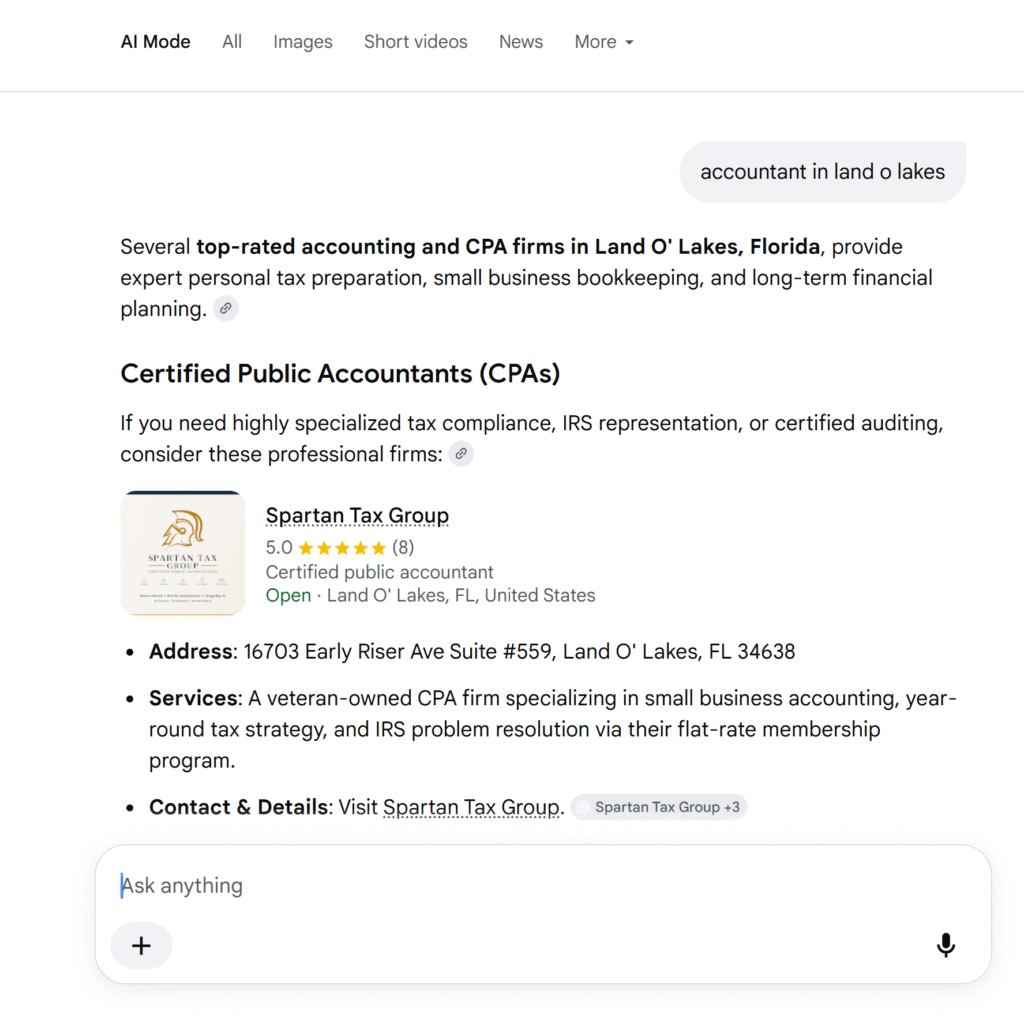
The result. Ask Google’s AI Mode for an “accountant in Land O’ Lakes” and Spartan Tax Group appears as a recommended firm for specialized tax compliance and IRS representation — with its address, its services, its open status, and its 5.0 rating pulled straight into the AI’s answer. For a local practice competing against far larger regional names, that is premium shelf space.
What these case studies reveal about improving brand visibility through AEO strategies
A national e-commerce brand and a small-town CPA firm don’t share much — except the playbook that got them cited:
- Be specific. Concrete, verifiable facts beat polished marketing language every time. Fog gets skipped.
- Earn outside validation. Reviews, community discussion, and third-party mentions are the proof AI trusts most — and most of its citations come from off your own site.
- Own your entity. Make who you are, what you do, and where you do it consistent and unmistakable everywhere it appears.
- Keep the SEO foundation strong. AEO is built on top of search eligibility, not instead of it.
- Move now. AI search is still mostly organic, with no ads competing for the answer and most competitors not even trying. That window closes.
Common questions about AEO
What is answer engine optimization (AEO)? AEO is the practice of structuring your content, data, and reputation so AI answer engines — Google AI Overviews and AI Mode, ChatGPT, Perplexity, Gemini — cite and recommend your brand when they generate a response. The goal is to be in the answer, not just ranked below it.
Is AEO different from SEO? It builds on SEO rather than replacing it. Strong search fundamentals get you into the candidate set an AI draws from; AEO adds the extractable structure, entity clarity, and third-party trust signals that decide whether you actually get cited. You need both.
Can you guarantee my brand will appear in AI answers? No, and you should be wary of anyone who claims they can. AI answers are probabilistic and change over time. What we can do is build the signals that reliably improve your odds — and measure where you appear so we know what’s working.
How long does AEO take to show results? It varies by how competitive your category is and how strong your existing footprint is. Local and niche categories often move faster than crowded national ones, because there is less to displace.
The answer is the new shelf
Being on page one used to be the prize. Increasingly, the prize is being in the answer — the one or two brands an AI names while a buyer is still deciding. Kaylaan and Spartan Tax show that improving brand visibility through AEO strategies is achievable on a real budget, in very different markets, by getting the fundamentals right and earning the trust signals AI looks for.
If you’d like to know whether your brand shows up when customers ask AI about your category — and what it would take to be the answer — that’s the work we do at Propellex.
Hire Propellex for GEO service.