Generative Engine Optimization (GEO) is quickly becoming the successor to traditional SEO, as more customers turn to AI-powered tools like ChatGPT, Google’s AI Overviews, and Perplexity to research products and services. If you’re a small business owner considering investing in GEO services, understanding the ROI of Generative Engine Optimization is essential, and you’re probably asking the most important question: is this actually worth the money?
Unlike traditional SEO, where ROI can be tracked through familiar metrics like keyword rankings and organic traffic, GEO introduces a new set of challenges. AI-generated answers don’t always link back to your website, and visibility inside a chatbot response isn’t as easy to measure as a page-one Google ranking.
This guide breaks down exactly how to evaluate the ROI of GEO services, so you can make an informed decision and hold your marketing agency accountable for real results.
What Makes GEO ROI Different from Traditional SEO ROI
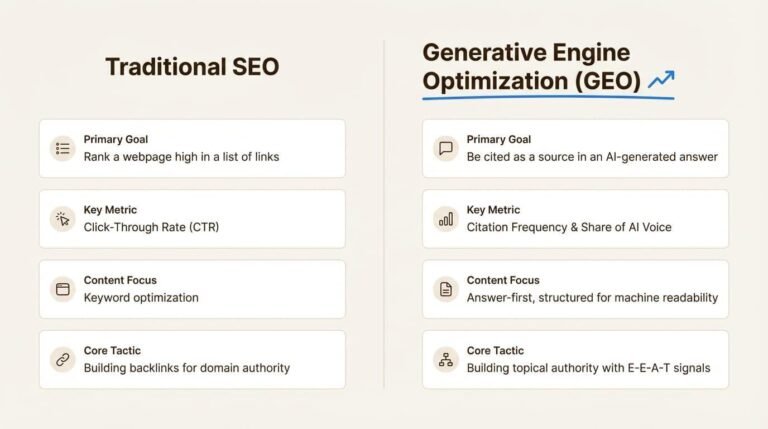
Before diving into metrics, it’s important to understand why GEO ROI requires a different approach than SEO ROI.
Traditional SEO revolves around search engine result pages (SERPs). You can track rankings, clicks, and conversions with tools like Google Analytics and Search Console. The customer journey is relatively linear: search, click, land on your site, convert.
GEO, on the other hand, focuses on how AI engines like ChatGPT, Gemini, and Perplexity summarize, cite, and recommend your business within conversational answers. Customers may never click through to your website at all. Instead, they might read an AI-generated summary that mentions your business by name, builds trust, and leads them to search for you directly or visit your location without ever clicking a traditional search result.
This means GEO ROI is often more about brand visibility and influence than direct traffic. Evaluating it requires blending new AI-specific metrics with traditional business outcomes.
Also read: How Agencies Differentiate GEO Services From Standard SEO Retainers
Key Metrics to Track for GEO ROI
1. AI Visibility and Mention Frequency
The first thing to measure is whether your business is actually showing up in AI-generated responses. This includes:
- How often your brand is mentioned by name in relevant AI queries
- Whether your business appears in AI Overviews on Google
- How you’re represented in tools like ChatGPT, Claude, or Perplexity when users ask about your industry or services
Several emerging tools now track “AI share of voice,” similar to how rank tracking tools monitor keyword positions. Ask your agency which tools they use to monitor this and how frequently they report on it.
2. Sentiment and Accuracy of AI Mentions
Simply being mentioned isn’t enough. You need to know how you’re being described.
Is the AI presenting your business accurately? Is it highlighting your strengths, or worse, pulling outdated information, incorrect pricing, or negative reviews into its summary?
Part of good GEO work involves ensuring AI engines have access to accurate, up-to-date, and positive information about your business through structured data, consistent NAP (name, address, phone) information, and authoritative content.
3. Referral Traffic from AI Platforms
While AI-driven traffic won’t look like traditional search traffic, it is trackable. Check your analytics for referral traffic sources like:
- chat.openai.com
- perplexity.ai
- gemini.google.com
- Bing Chat
These sources indicate that someone read about your business in an AI conversation and clicked through to learn more. Growth in this referral category is a strong indicator that your GEO investment is paying off.
Also read: AEO Tools for Brand Mentions: How to Track and Improve Your Visibility in AI Search
4. Direct and Branded Search Traffic
One of the biggest indirect indicators of GEO success is an increase in direct traffic and branded search queries (people searching your business name specifically).
If AI tools are recommending your business, users often won’t click a link. Instead, they’ll open a new tab and search your business name directly, or type your URL into their browser. A steady increase in this type of traffic often signals growing brand awareness driven by AI visibility.
5. Lead Quality and Conversion Rates
At the end of the day, visibility means nothing if it doesn’t translate into leads and revenue. Track:
- Number of new inquiries or form submissions
- Phone calls, especially those tagged with call tracking software
- Conversion rates from AI-referred traffic compared to other channels
If your agency can demonstrate that leads originating from AI-influenced discovery are converting at a healthy rate, that’s a strong signal of real ROI.
How to Calculate GEO ROI
Once you have these metrics in place, calculating ROI follows a similar formula to any other marketing channel:
ROI = (Revenue Generated from GEO Efforts − Cost of GEO Services) / Cost of GEO Services
The challenge is attributing revenue accurately. Since GEO often influences the awareness and consideration stages of the buyer journey rather than driving last-click conversions, consider using a multi-touch attribution model rather than last-click attribution alone. This gives credit to GEO-driven visibility even if the final conversion happened through a different channel, like a direct visit or phone call.
Set a Realistic Timeline
GEO is still an emerging field, and AI models don’t update their training and indexing in real time. It typically takes three to six months to see meaningful shifts in AI visibility and mentions. Set expectations with your agency accordingly, and avoid judging ROI based on the first 30 days.
Questions to Ask Your GEO Agency
To properly evaluate whether your GEO investment is delivering ROI, ask your agency these key questions:
- What tools do you use to track AI visibility and mentions?
- Can you provide before-and-after examples of how our business appears in AI-generated answers?
- How do you tie GEO efforts to measurable business outcomes, like leads and revenue?
- What is your reporting cadence, and what metrics will be included?
- How do you handle inaccurate or outdated information about our business appearing in AI results?
A transparent, results-driven agency should have clear answers to all of these questions, along with a reporting dashboard that ties GEO activities to tangible business metrics.
Also read: RFP Questions for Generative Engine Optimization (GEO) Services: A Complete Guide
Red Flags to Watch For
Not all GEO services are created equal. Be cautious of agencies that:
- Cannot explain how they measure AI visibility
- Promise guaranteed rankings or mentions in AI tools (no one can guarantee this, as AI models are proprietary and constantly evolving)
- Focus solely on technical jargon without connecting efforts to business outcomes
- Provide vague, generic reports without specific data tied to your business
Final Thoughts
Evaluating the ROI of Generative Engine Optimization services requires a shift in mindset from traditional SEO metrics. Instead of focusing exclusively on rankings and clicks, you need to track AI visibility, referral traffic, branded search growth, and lead quality, then tie these metrics back to real revenue using a multi-touch attribution approach.
GEO is still a relatively young discipline, but the businesses that invest early and measure results carefully will be best positioned to capture new customers as AI-powered search continues to reshape how people discover local businesses.
If you’re evaluating a GEO agency, prioritize transparency, realistic timelines, and clear reporting. A good partner won’t just tell you they’re “optimizing for AI.” They’ll show you exactly how that optimization is translating into visibility, traffic, and revenue for your business.
Looking to improve your visibility across AI-powered search platforms? Hire Propellex for GEO Services and build a stronger presence in ChatGPT, Google AI Overviews, Perplexity, and more.