How to Get Found When AI Answers the Questions Your Customers Are Asking
The way people search for local services is changing fast. A homeowner no longer just types “plumber near me” into Google and scrolls through a list of blue links. Instead, they ask ChatGPT, Google’s AI Overview, or Perplexity a question like, “Who is the best emergency plumber in Austin that’s available on weekends?” — and they expect a direct, confident answer.
If your local service business isn’t optimized for that kind of AI-powered response, you’re invisible to a growing segment of your market.
That’s where Generative Engine Optimization (GEO) comes in — and for local service businesses, it may be the most important marketing strategy you adopt in the next two years.
What Is Generative Engine Optimization (GEO)?
Generative Engine Optimization is the practice of structuring your online content, reputation, and digital presence so that AI-powered search engines — like Google’s AI Overviews, ChatGPT with browsing, Perplexity, and Bing Copilot — confidently recommend your business in their responses.
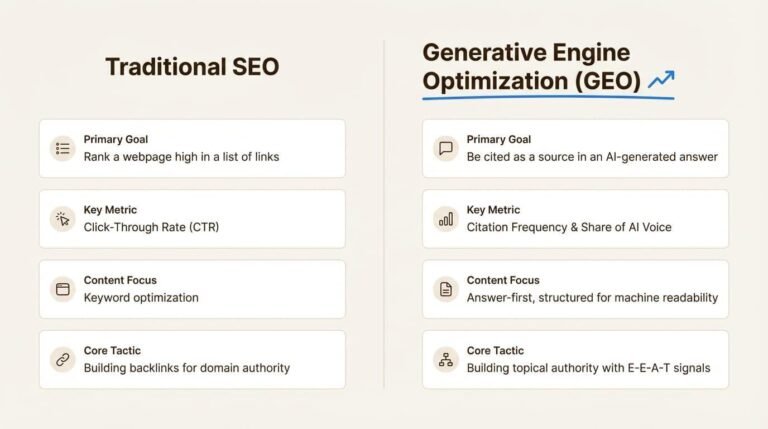
Unlike traditional SEO, which focuses on ranking on a results page, GEO focuses on becoming the source that AI trusts and cites.
How GEO Differs from Traditional SEO
| Traditional SEO | Generative Engine Optimization |
| Ranks pages on SERPs | Gets cited in AI-generated answers |
| Targets keywords | Targets questions and conversational queries |
| Builds page authority | Builds entity authority and trustworthiness |
| Click-through rate matters | Being mentioned matters |
For local service businesses, this distinction is critical. AI engines don’t just rank you — theyvouch for you by name in their answers.
Also read: RFP Questions for Generative Engine Optimization (GEO) Services: A Complete Guide
Why Local Service Businesses Need GEO Right Now
Local service businesses — plumbers, electricians, HVAC technicians, landscapers, dentists, lawyers, and more — are among the most searched categories in AI chat tools.
When someone asks an AI assistant, “What’s a trustworthy HVAC company in Denver?”, the AI pulls from a combination of:
- Indexed web content
- Review platforms (Google, Yelp, Angi)
- Business directories and citations
- News mentions and local press
- Structured data on your website
If your business has a weak digital footprint, the AI simply won’t mention you. It will recommend competitors who have invested in their online presence — even if you deliver better service.
The Local Intent Gap
Most local businesses are still optimizing for 2019-era SEO. They’re focused on keyword density and backlinks while ignoring the conversational, question-based way AI tools surface local recommendations.
GEO closes that gap.
The Core Pillars of GEO for Local Service Businesses
1. Establish a Clear, Consistent Business Entity
AI systems are built on vast databases of structured information. They need to clearly understand who you are before they can recommend you.
- Use your exact business name, address, and phone number (NAP) consistently across every platform.
- Claim and fully complete your Google Business Profile, including services, hours, photos, and Q&A.
- List your business on authoritative directories: Yelp, Angi, Thumbtack, Houzz, BBB, and industry-specific platforms.
- Use Schema markup (LocalBusiness, Service, Review) on your website to speak directly to AI crawlers.
The more consistently your entity data appears across the web, the more confidently AI tools will reference you.
2. Create Content That Answers Real Customer Questions
AI engines are built to answer questions. Your website content should mirror the way your customers actually speak when they need help.
Stop writing: “We offer affordable HVAC services in Denver.”
Start writing: “How much does it cost to replace an HVAC unit in Denver? Here’s what homeowners should know.”
Question-Based Content Ideas for Local Service Businesses
- “How long does a roof replacement take in [your city]?”
- “What should I do if my water heater stops working overnight?”
- “Is [your service] covered by homeowners insurance in [your state]?”
- “How do I choose a licensed electrician in [your city]?”
Create dedicated FAQ pages, service area pages, and blog posts built around these questions. Use natural, conversational language. AI tools love content that directly answers a specific question clearly and completely.
3. Dominate Your Review Presence
Reviews are one of the most powerful signals AI engines use when evaluating local service businesses. A business with 400 Google reviews averaging 4.8 stars is going to appear in far more AI-generated recommendations than a competitor with 12 reviews.
Your review strategy should include:
- Asking every satisfied customer for a Google review (consider using automated follow-up texts or emails)
- Responding to every review — positive and negative — in a professional, detailed way
- Building reviews on multiple platforms (Google, Yelp, Facebook, Nextdoor)
- Encouraging customers to mention specific services in their reviews, since AI can extract that context
A review that says “Called at 11pm for a burst pipe and they arrived within an hour — truly the best emergency plumber in Phoenix” is pure GEO gold.
4. Build Local Authority Through Mentions and Citations
AI models are influenced by what the broader web says about you. This is sometimes called entity authority — essentially, how well-known and trusted your business is as a recognized local expert.
Ways to build local entity authority:
- Get featured in local news articles or neighborhood blogs
- Contribute expert quotes to local online publications
- Sponsor community events and get mentioned on event websites
- Partner with complementary local businesses for cross-mentions
- Join your local Chamber of Commerce and appear on their directory
Each mention of your business name online — especially paired with your city and service type — signals to AI that you are a real, established, trusted local business.
5. Optimize for Conversational, Long-Tail Queries
Traditional SEO chased short keywords like “Denver plumber.” GEO requires you to think in full sentences and scenarios.
Think about the intent behind the question, not just the words. Someone asking “Is it safe to use my furnace if it’s making a banging noise?” is moments away from calling an HVAC company. If your content answers that question with authority and includes a clear call to action, AI tools may cite your page — and that person may call you directly.
Use tools like AnswerThePublic, AlsoAsked, or simply Google’s “People Also Ask” section to discover the exact questions your customers are asking.
Also read: GEO: Generative Engine Optimization Best Practices for Financial Services
Measuring GEO Success for Local Businesses
GEO results look different from traditional SEO metrics. Here’s what to track:
AI citation frequency — Manually query ChatGPT, Perplexity, and Google’s AI Overviews using your service + city keywords. Are you being mentioned?
Branded search volume — More people searching your business name directly signals growing brand authority
Review velocity — Are you consistently earning new, high-quality reviews?
Direct traffic and phone calls — AI-driven recommendations often result in direct website visits or calls, not tracked clicks
Conclusion: The Local Businesses That Win Tomorrow Are Optimizing for AI Today
The shift toward generative AI search isn’t coming — it’s already here. Every day, potential customers in your service area are asking AI tools for recommendations, and those tools are making decisions about which businesses to trust and mention.
Generative Engine Optimization gives local service businesses a real competitive edge. By building a consistent entity presence, answering customer questions with quality content, accumulating powerful reviews, and earning local mentions, you position your business to be the name that AI recommends — again and again.
The businesses that understand GEO now won’t just survive the AI search revolution. They’ll thrive in it.
Start optimizing for the future of local search today — before your competitors do.
Hire Propellex for GEO Service